important sofa stuff...
things we know...

Five year construction guarantee.
All our sofas carry a five year construction
guarantee. It covers the feet and frame, springs, webbing, and
sofabed mechanisms. Everything you can't see, except the seat
cushion fillings. But don't worry about them. They'll retain their
shape and comfort for years. Why? Read on.
Underneath it all: the sturdy frame.
We've tried a variety of ways to improve
frames. But actually the traditional European hardwood is best,
pinned and glued (to a five-year guarantee). Retro shapes are
really tricky to make. Stane Street had its frame prototyped by a
surf board manufacturer. What a dude.
The cushion.
Our in-house experts, (my wife, Julia and
David's wife, Jenny) have found that when someone's unhappy with a
sofa, the seat cushions are mostly to blame.
So we use a new cushion called the
Duratech. It's made from the same stuff as fleece jackets. And it's
the only seat cushion ever to receive a gold star from FIRA (the
Furniture Industry Research Association).
It has been tested by having a
15-stone man sit on it for five years, (the equivalent anyway).
When he finally got up, the cushion had kept 95% of its loft. In
other words, five years after you bought it, the cushion would look
and feel almost the same. It's the only cushion to win a gold star
from the Furniture Industry Research Association (FIRA), so we use
it in most of our sofas.
Washable loose covers.
Ideal for grubby fingers and muddy dogs,
obviously been around for ever. But in fact, not before 1989. That
year I found them at Shabby Chic, in SoHo, New York. Brilliant, I
thought, and brought the idea home.
Then I found how tricky they were to make. But
we ironed out the manufacuring wrinkles, and we've been making
really good washable loose covers ever since.
Top tip! Never wash your covers above 30°C or
tumble-dry them. They'll shrink. Fit them still damp, and tuck them
in with a wooden spoon.
A dream in leather.
At one time leather sofas all looked Victorian
and sat like a brick. And only lads bought them. Basically the
tanning process made them that way. I wanted to come up with
something better, and from 1988, I tried with a Dutch tannery.
Progress was slow.
But when my wife Julia (no fan of leather
sofas) told me how lovely and soft the sofa in our showroom was, I
knew we'd cracked it. Soft leather! Now, even though most sofas are
bought by women, over half the sofas sold in the UK are
leather.
protecting your sofa...
A sofa is not just for Christmas. Here's how to
give your sofa a good home and make sure you have a long and
comfortable life together.
Fabric protection from 'Staingard' and leather
protection from 'Leather Master'.
You've just bought a beautiful sofa from Sofas
& Stuff. You celebrate with a glass of Chianti and an old
friend. Cheers! Whoops.
What to do with that stain? No fabric
protection plan? Now you do have a problem, and you're about to
make it worse trying to get the stain out.
But wait! Here's 'Staingard' and 'Leather
Master'.
Both 'Staingard' fabric and 'Leather Master'
leather protection plans costs £40 a seat, about one trip to the
dry cleaners, but it's a whole lot more effective.
It starts with a box of impregnated cloths to
deal with most stains. If they don't, ring for the 'protection
man'. He'll come round and take away the stain. If he can't, he'll
replace the cushion cover. If that doesn't work, we replace the
whole sofa. Phew! It's worth getting, trust me.
 |
 |
|
Staingard fabric protection contents:
|
Leather Master leather protection contents:
|
|
General Purpose Mild Cleaner
A gentle cleaner ideal for the removal of
general light soiling on most kinds of fabrics.
Old or Resistant Stain Remover
A water based product ideal for the removal
of stubborn, old or dried stains.
Fresh Stain Remover
A water based product ideal for removing
fresh stains from most fabrics.
Grease and Oil Stain Remover
A water based product ideal for the removal
of grease and oil based stains.
|
Protection Cream
A highly effective, water-based cream that creates an invisible
barrier on your leather, offering protection against staining and
general soiling. Using Protection Cream allows you to clean most
everyday household spills and stains.
Super Cleaner
A specialised cleaner that is especially effective on those
difficult to remove stains, such as newspaper print and dye soiling
from clothes.
Soft Cleaner
An excellent general cleaner that will remove everyday spills
and dirt from your leather. Used as part of a regular maintenance
programme, it will keep your furniture looking like new for
longer.
Ink Away
An easy to use stick that comes in a handy lipstick style
dispenser. It is a highly effective remover of ball point ink and
lipstick
|
Fabric Fading.
A truth not often admitted...
All fabrics fade in direct sunlight. It's the
ultra-violet rays.
Some fade faster than others. How quickly
depends on what they're made from, and the dye used. Really bright
colours are the worst for fading, and exposed to direct sunlight
coming through glass, they'll fade even faster. A sun-lounge
without protective blinds is not a friendly place to put a
sofa.
All our fabrics are rigorously tested for what
is called "lightfastness", or resistance to fading. They'll perform
sterling service for you, but it's definitely a good idea to keep
them out of the sun.
Break this rule at your peril.
Plump. Plump it up.
I am a world expert plumper. I think every time
someone gets off a sofa it should be plumped to make it look its
best. But if you think that's excessive, a good plumping once a
week, giving the cushions a bash keeps duck feather back cushions
from looking sad and squashed. Swap over left and right hand
cushions to even out fabric wear and fading from direct
sunlight.
looking after your sofa...
To wash, or not to wash?
Rule of thumb.
Washable fabrics come on sofas where the whole
loose cover can be taken off. If you only have removable cushion
covers don't be tempted to wash them in the machine. They'll shrink
and come out crumpled.
Cleaning instructions.
Check the cleaning instructions! Follow them! A
fabric can be only washed, say the experts, so long as it shrinks
by less than 3%. Washable fabrics have the bucket symbol on the
cleaning instructions label, with 30° or 40° in the bucket.
These fabric ranges are washable: Bailey,
Biscay, Cromarty, Dover, Malin, Lundy, Trafalgar, Thames.
 |

|

|
 |

|
Iron, Low
Regular ironing, steam or dry, may be performed at
low setting (110C, 230F) only.
|
Iron, Medium
Regular ironing, steam or dry, may be performed at
medium setting (150C, 300F)
|
Iron, High
Regular ironing, steam or dry may be performed at
high setting (200C, 290F).
|
Dryclean, Any Solvent Except Trichloroethylene
Any dry cleaning solvent other than
trichloroethylene may be safely used.
|
Dry in Shade
Usually added to line or drip dry. Dry away from
direct sunlight.
|
 |
 |
 |
 |
 |
Do Not Tumble Dry
A machine dryer may not be used. Usually
accompanied by an alternate drying method symbol.
|
Machine Wash,
Cold
Initial water temperature should not exceed 30C or
65 to 85F.
|
Machine Wash,
Warm
Initial water temperature should not exceed 40C or
105F.
|
Hand Wash
Garment may be laundered through the use of water,
detergent or soap and gentle hand manipulation.
|
Do Not Bleach
No bleach product may be used. The garment is not
colorfast or structurally able to withstand any bleach.
|
Loose covers.
Top tip. Don't overload your washing machine.
If you have to stuff your loose cover into the machine, stop. Take
it from me, you're overloading it. It may damage your covers and
your machine. Wash the base and cushion covers for your sofa
separately.
All about our fabrics
At Sofas & Stuff we are very touchy feely.
We don't have a daily staff group hug, but we do make sure our
fabrics are just as good to look at as they are to touch and sit
on.
I've spent a long time, weeks probably over the
last twenty years, in the baking hot handloom sheds of Kerala,
south India, getting sweaty choosing yarns and designing stripes
with Sanjay in Cannanore.
But I still love watching handloom weavers pass
the shuttle back and forth to make a few inches of wondrous fabric.
Or chasing down the perfect kelim in central Turkey. It's worth
travelling for a really good kelim weaver. Much better quality than
Istanbul's tourist trade offers.
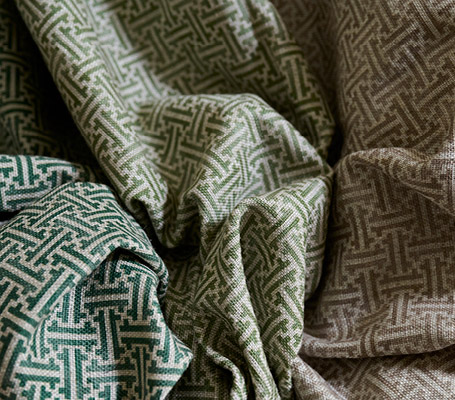
I don't have to go as far for our linen cotton
mixes. They're made in UK mills. We're proud of that.
We've suggested what works well for different
sofas. Chenille works best as a tight-cover; linen or cotton-linen
for loose covers; cotton for washable covers.
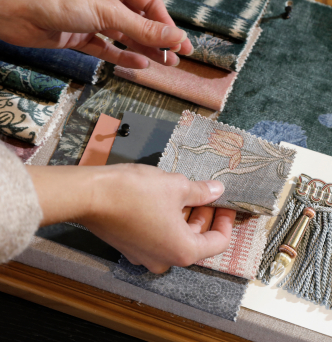
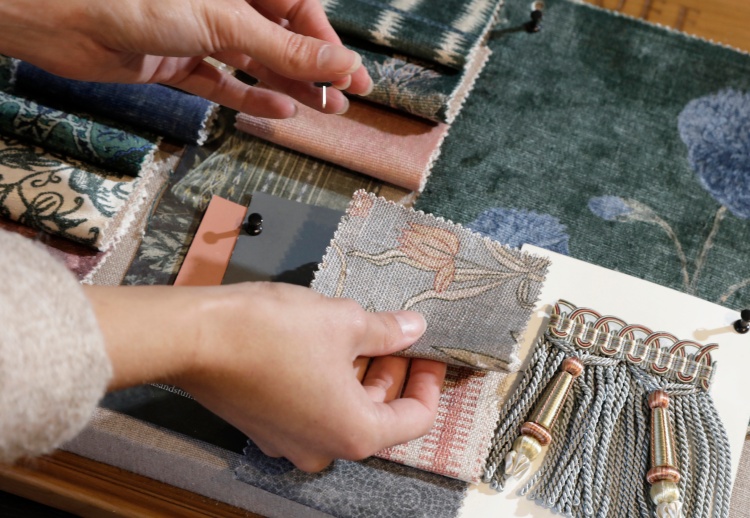
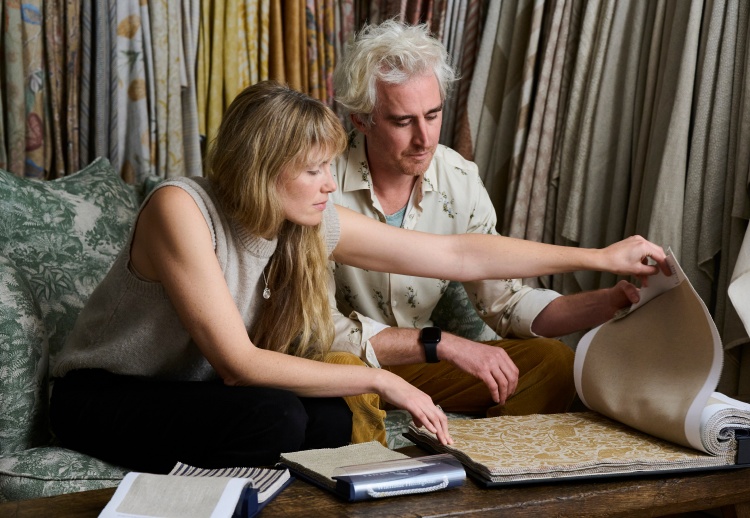
We couldn't buy a fabric without holding it in
our hands.
We wouldn't want you to either.
If you fill out our fabric request form, 24
hours later we'll send out berry coloured velvet, dark chocolate
cotton, soft striped chenille… whatever your heart desires.
 |
Chenille
Chenille is a French word meaning
caterpillar, and it's true that the soft ridges of chenille fabric
have something of a fuzzy caterpillar look. Chenille can be made
from natural fibres like cotton or rayon (derived from wood) or
man-made acrylic fibres.
|
 |
Velvet
Velvet is a fabric with a thick soft pile,
cut so the ends of the yarns form the surface, lending it a
luxurious feel. You can achieve many effects with velvet. If the
pile is brushed in one direction, for example, the cloth has a very
rich, high sheen.
|
 |
Linen
An ancient fabric made from the Flax plant
and valued for its cool, fresh feel. It's considered a tad more
exotic than humble cotton. Linen ages well, but is susceptible to
colour change in strong direct natural light. It uses far less
water in processing than cotton, a plus for the ecologically
minded. My favourite.
|
 |
Cotton
The most widely used natural fibre in
clothing and furnishings because of its soft, breathable and stable
nature. As a plant it flourishes in tropical and subtropical
climates.
|